
Free draw
Tarot of Marseille — draw 3 cards
Ask your question, then reveal your past, present, and future.
Past
Present
Future
Tarot deck
Tarot of Marseille
The classic reference of French cartomancy, sober and powerful.
The Tarot of Marseille is the reference deck of the French divinatory tradition, recognizable by its geometric figures and bold colors inherited from wood engraving.
The Tarot of Marseille refers to a set of standardized decks produced mainly in France — in Marseille, Lyon, and Avignon — from the 17th century onwards. Its iconography draws from older traditions: the first Italian tarots of the 15th century, whose motifs evolved as they crossed the Alps. The term 'Tarot of Marseille' was popularized in the 20th century by the cartomancer Paul Marteau, whose 1930 edition established a canonical version that is now the most well-known. Marseille engravers and card makers played a central role in standardizing the design and colors — blue, red, yellow, green. There is no single inventor or precise date of birth: it is a collective tradition, refined over several generations of artisans.
The Tarot of Marseille consists of 78 cards in two sets. The 22 major arcana — from The Magician to The World, including The High Priestess and The Wheel of Fortune — represent universal archetypes and form the symbolic core of the deck. The 56 minor arcana are divided into four suits (wands, cups, swords, coins), each with ten numbered cards and four court cards. Unlike illustrated tarots, the numbered cards of the Marseille do not feature figurative scenes: their interpretation relies on the symbolism of numbers and colors. A cross, horseshoe, or star spread allows for exploring a situation from multiple angles, inviting both reflection and intuition.
The Tarot of Marseille is aimed at those seeking a reading rooted in a long tradition and a refined symbolism. Its schematic images invite one to project their own experiences and activate intuition without overly explicit narration. It excels at exploring fundamental questions: direction, relational dynamics, or inner blockages. Divination remains a space for enlightened reflection and entertainment: the cards open pathways, they do not replace professional guidance.
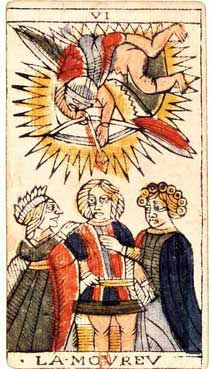
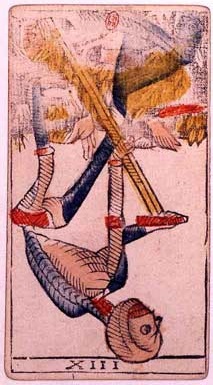
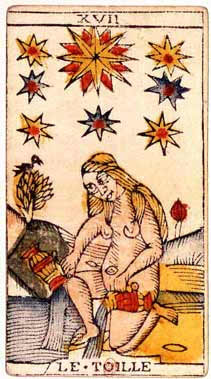
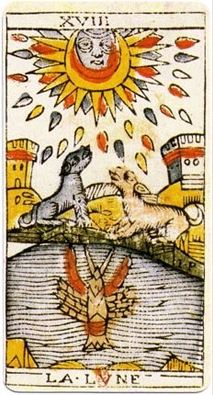
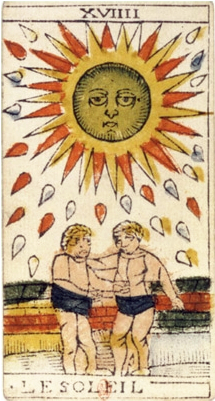
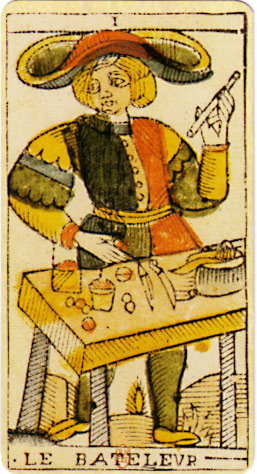
Major Arcana (public domain).
What is the difference between the Tarot of Marseille and the Rider-Waite?
The Marseille features numbered cards without illustrated scenes, while the Rider-Waite illustrates each card. The Marseille emphasizes the symbolism of numbers and colors; the Rider-Waite facilitates intuitive reading through its narrative images.
Is the Tarot of Marseille difficult for a beginner?
It requires a slightly more structured learning process, as its minor arcana do not include scenes. With some basics on the symbolism of the suits and numbers, it quickly becomes a very rich tool for reflection.
Ready to ask the cards?
Ask your question and receive a personalized reading, for free.
Get a free readingvoyancego is entertainment. Readings do not replace any medical, legal, or financial advice.